
NASA's twin ESCAPADE spacecraft swung past Earth on November 7 and 9, using its gravity like a slingshot to head for Mars. It doesn't affect you at all, but it shows you how to tell an official notice from a viral video of strange lights.
Understand how Earth's gravity gives a spacecraft a boost, and know where to check before you forward an alarming video.
To reach Mars, they came back to Earth first
Two NASA spacecraft are on their way to Mars. To get there, they did something that sounds backward: before heading out, they swung back past Earth, and not just once but twice. That raises an obvious question: how can a planet push you without touching you? The answer involves gravity, a little engine power, and a plan NASA made public days before it happened.

A long road trip with no gas stations
In 1971, Mariner 9 became the first spacecraft to orbit another planet. Today, two twin spacecraft called ESCAPADE, sent by NASA and UC Berkeley, are heading out to study from orbit how Mars lost its air. The challenge is a lot like a long road trip: the more fuel you carry, the heavier everything gets. A spacecraft works the same way, and there are no gas stations in space. So instead of hauling more fuel, they borrow a boost from Earth's gravity.

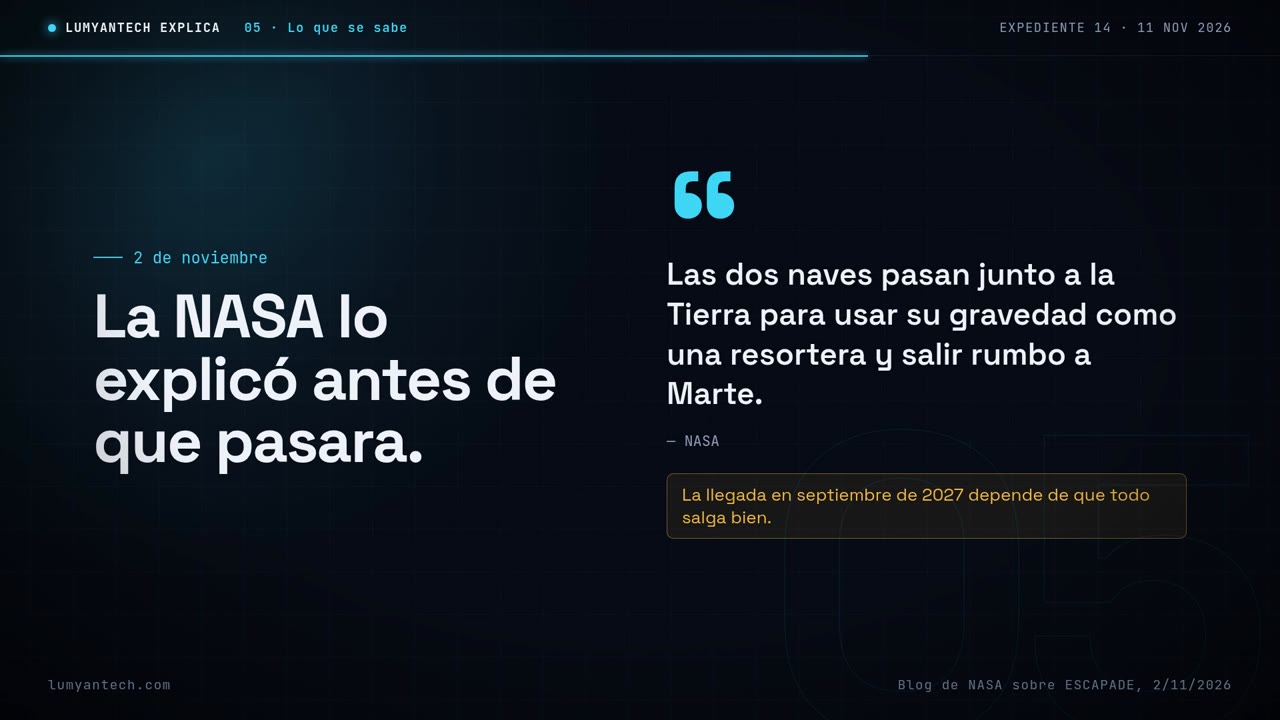
Earth as a giant slingshot
Picture a sling: the stone whips around and flies off when you let go. The spacecraft does something similar. It approaches Earth, gravity bends its path, and it gets released with extra speed toward Mars. It doesn't just coast, either. While passing close, it fires its engine, so gravity and engine push together. For NASA, it's a plan with a date and time. But when something passes near Earth, it's easy to get a late-night video with creepy music that you feel like sending to everyone. That's exactly when to pause.

Announced days in advance
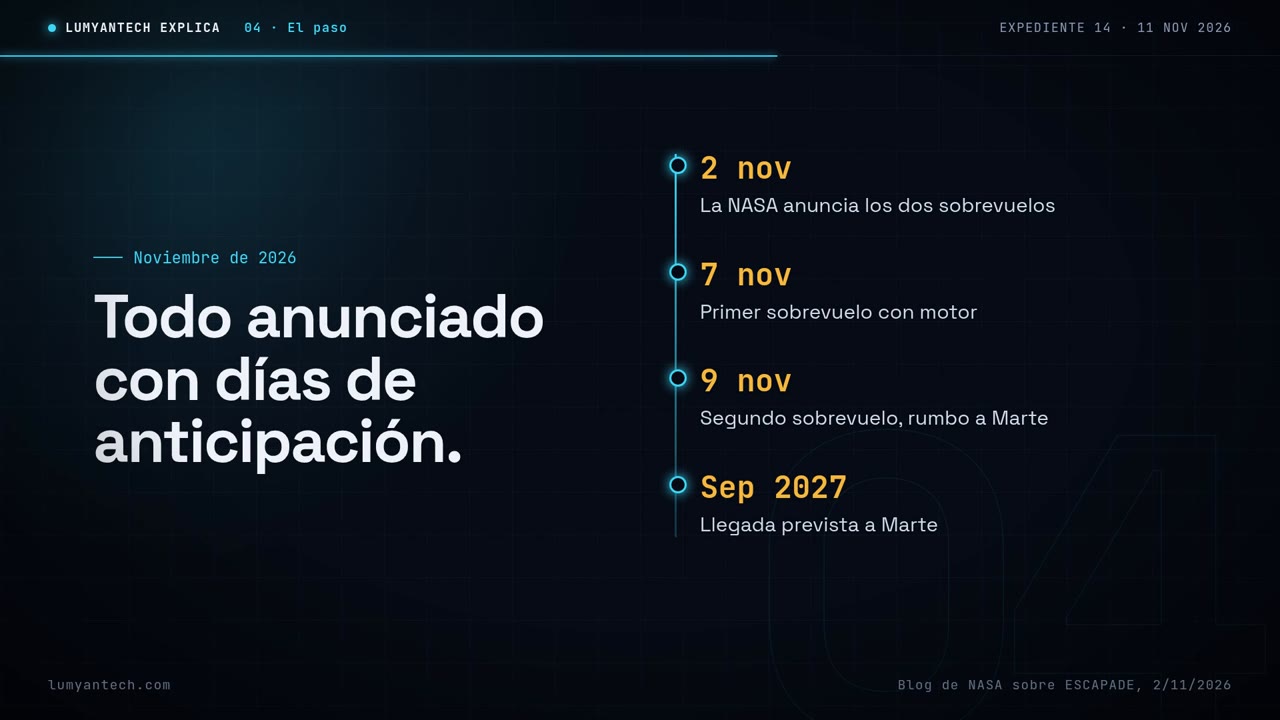
None of this was a surprise. NASA announced the maneuver on November 2, 2026. The first flyby happened on November 7 and the second on November 9. If all goes well, both spacecraft will reach Mars in September 2027. There was a date, a mission name, and a public explanation before anything came near Earth.
What we know and what we don't yet
NASA explained the maneuver before it happened, and it used the same image: a slingshot. It was a powered flyby, planned in advance with a published trajectory, not some dangerous object out of control. The only thing that isn't guaranteed is the arrival at Mars, which depends on how the rest of the trip goes. For now, September 2027 is the expected date if everything goes as planned.
No impact on your phone, internet, or anyone here
So how does this affect you? It doesn't. The maneuver only involves the ESCAPADE mission. It doesn't touch your phone, the internet, your website, or any service here on the ground. There's nothing to install and nothing you need to do. What does help is knowing where to look: these maneuvers come with dates and trajectories published on NASA's website, and based on the official sources, that's the place to confirm whether something is real.

The real notice vs. the viral video
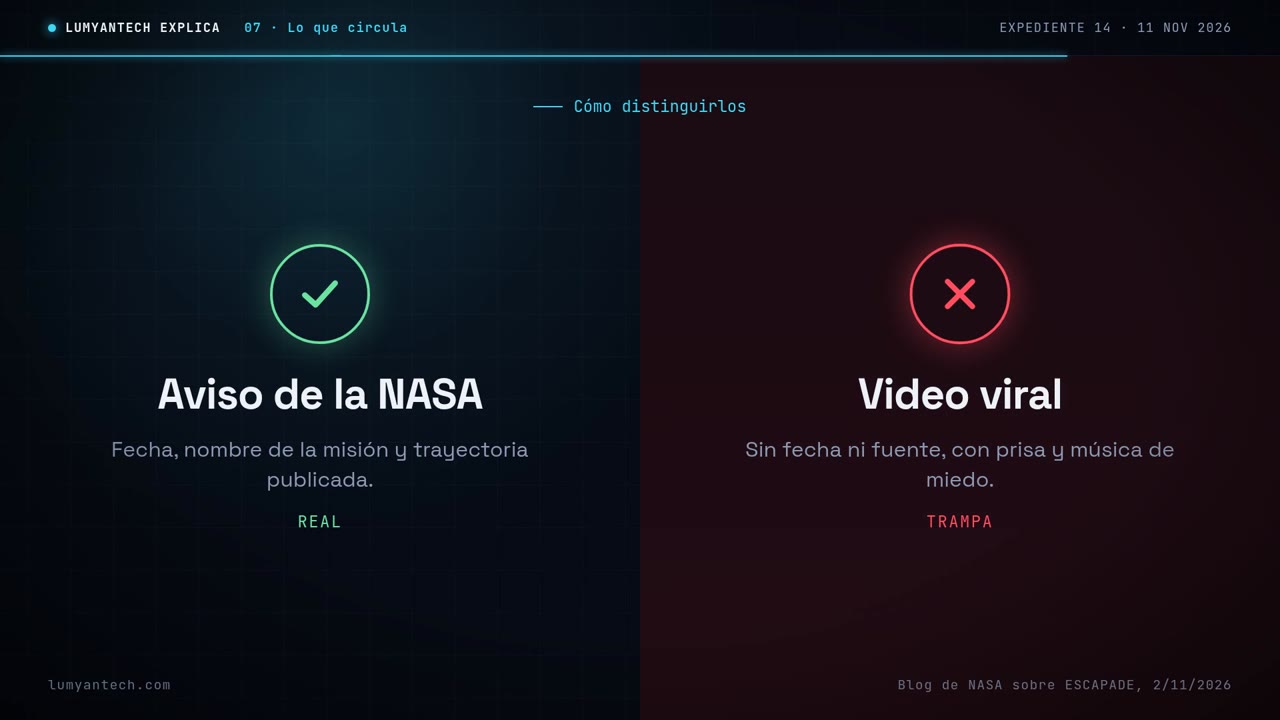
The difference is obvious once you put them side by side. The real notice tells you what it is, when it happens, and what it's called. In this case: two spacecraft from the ESCAPADE mission, flybys on November 7 and 9, headed for Mars. The viral video of strange lights tells you none of that. No date, no location, no source, yet it urges you to share it right now. That urgency is your cue to slow down.
Four rules before you hit forward
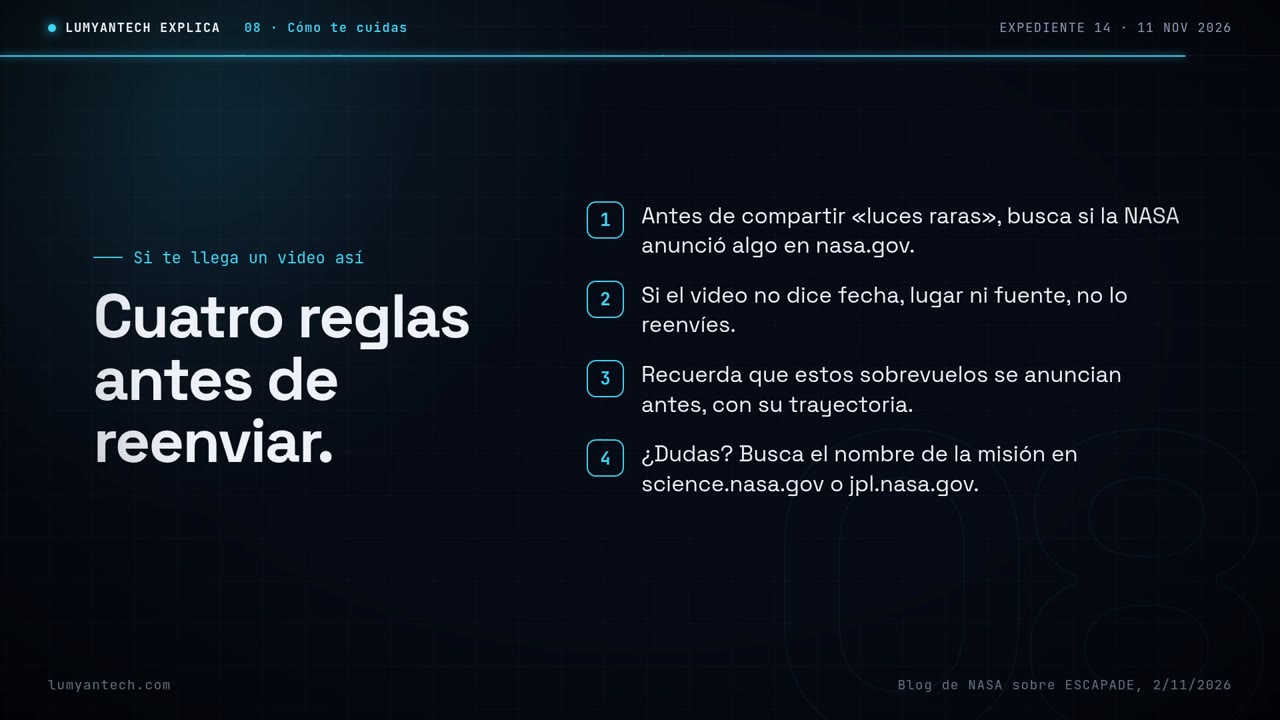
If someone sends you a video of strange lights in the sky, run through these four rules before you pass it along.
A real notice tells you what it is, when it happens, and what it's called; a video that tells you none of that isn't worth forwarding.
Sources
- science.nasa.gov · science.nasa.gov
- science.nasa.gov · science.nasa.gov
- news.berkeley.edu · news.berkeley.edu
Verified on November 13, 2026
Would you rather we handle it? Book a call